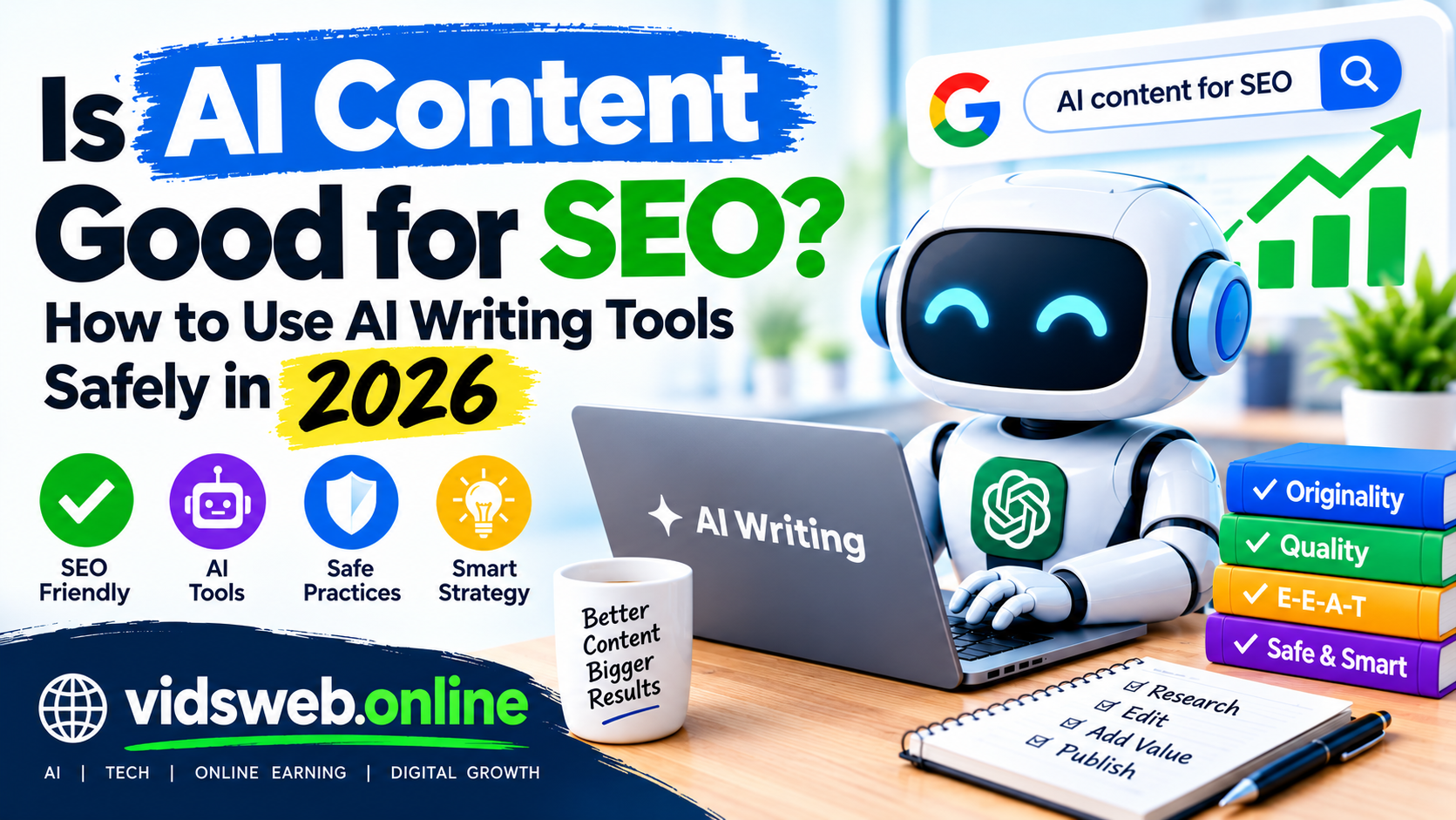
Artificial Intelligence (AI) has completely changed the way we create content. From bloggers to big digital marketing agencies, almost everyone is using tools like ChatGPT, Claude, and Gemini to speed up their writing process.
But a big question remains for every website owner: Is AI content good for SEO, and will Google penalize your website for using it? Let’s dive deep into the facts and look at how you can use AI content safely to grow your website in 2026.
1. What is the official position of Google regarding AI content?
Many bloggers believe that Google hates AI content, but that is a major misconception. Google has clearly stated that it focuses on the quality of the content, not how it was created. www.google.com
Google uses the E-E-A-T framework to rank articles:
- E – Experience (Tajiurba)
- E – Expertise (Maharat)
- A – Authoritativeness (Haqqaniyat)
- T – Trustworthiness (Bhorosa)
If your AI-generated article provides real value, gives accurate information, and helps the reader, Google will rank it. However, if you just copy-paste automated text without checking it, your site will suffer.
2. The Dangers of Pasting Unprocessed AI Content
While AI tools are incredibly smart, relying 100% on them without human editing can hurt your website in the following ways:
- Plagiarism and Repetitive Text: AI tools often rewrite existing web data, which can lead to unintentional plagiarism or generic text.
- Inaccurate Facts (Hallucinations): AI can sometimes create fake facts, numbers, or outdated data confidently.
- Lack of Human Emotion: AI cannot share personal stories, real-life experiences, or unique human perspectives that readers love.
3.How to Safely Utilize AI Content (The Human+AI Formula)
If you want Google AdSense approval and high rankings, you should never publish raw AI content. Instead, follow this simple workflow:
- Use AI for Brainstorming: Use AI to generate article outlines, catch titles, or research keywords.
- Rewrite and Humanize: Change the sentence structure. Add your own voice, local examples, or personal opinions to the text.
- Fact-Check Everything: Always double-check names, dates, dates of events, and statistical figures generated by AI.
- Add Multimedia: Boost your post’s value by adding high-quality images, custom infographics, or helpful videos.
4. Conclusion
AI content is a powerful tool, but it should be used as an assistant, not a replacement for human writers. In 2026, the key to SEO success is balance.
Use AI to save time, but add your unique human touch to ensure your content stands out from the crowd.