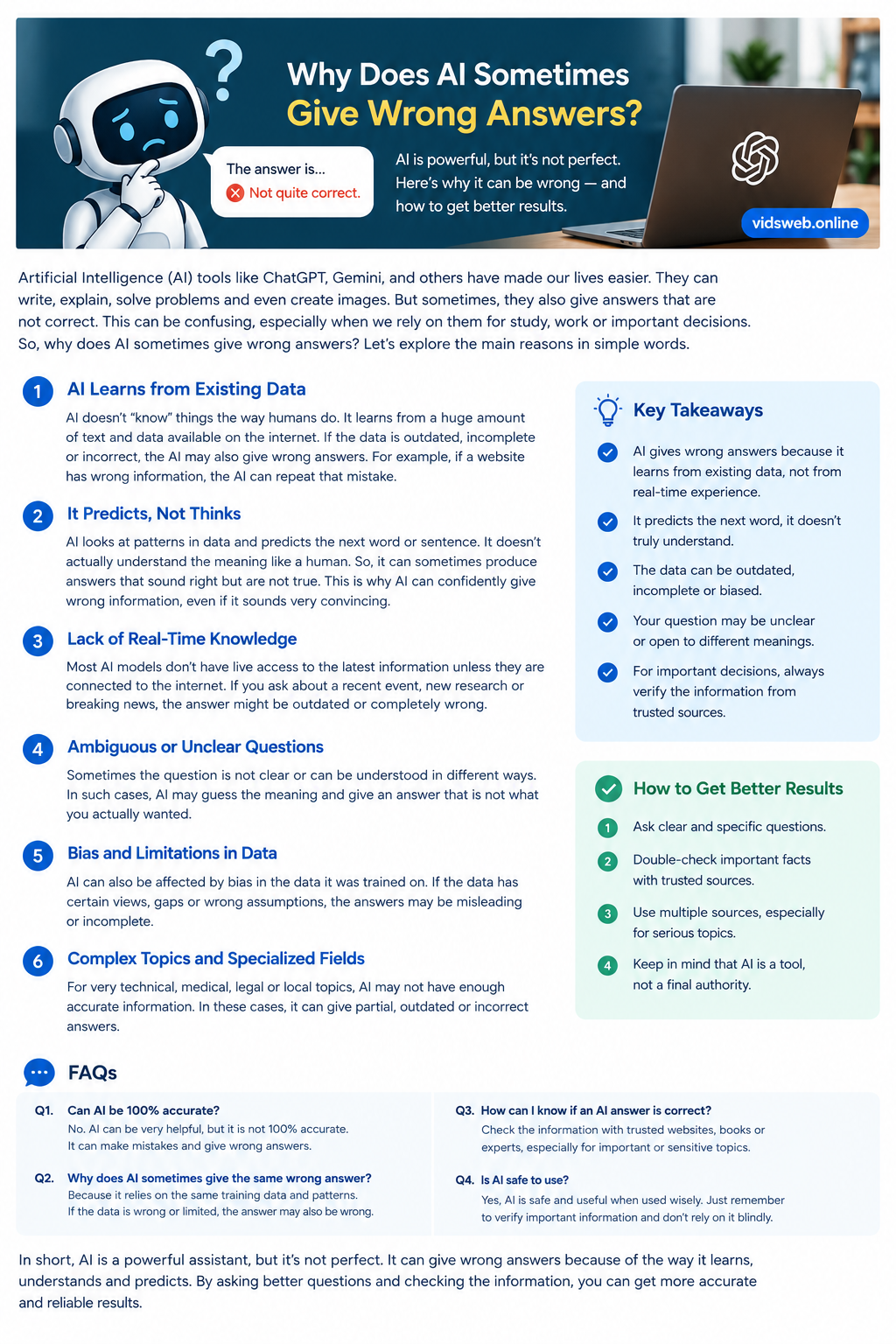
Artificial Intelligence (AI) tools such as ChatGPT, Google Gemini, and other AI assistants have changed how people search for information, write content, learn new skills, and solve everyday problems. They can explain difficult topics, summarize documents, generate ideas, and help users complete tasks more quickly.
However, AI does not always provide correct answers. Sometimes it gives outdated information, misunderstands a question, produces incorrect facts, or confidently explains something that is simply not true.
This can be confusing, especially for people who use AI for education, research, business, or content creation. Understanding why these mistakes happen can help you use AI more effectively and avoid relying on misleading information.
In this guide, we will explain why AI sometimes gives wrong answers, explore practical examples, and share simple ways to improve the accuracy of AI-generated responses.
What Does It Mean When AI Gives a Wrong Answer?
An incorrect AI answer can take several forms. The tool might provide a false fact, misunderstand the user’s request, use outdated information, or generate a response that sounds reasonable but contains errors.
For example, you might ask an AI assistant to summarize a document. If the document does not contain a particular detail, the tool may still produce a statement that appears relevant but is not supported by the original text.
In another situation, you might ask about a recent software update. If the AI does not have access to current information, it may describe an older version instead of the latest release.
These mistakes do not necessarily mean that the entire AI system is useless. They show why its answers need to be evaluated carefully, particularly when accuracy matters.
1. AI Learns from Existing Data
One important reason AI sometimes gives incorrect answers is the information used to develop it.
Many AI models are trained on large collections of text and other data. This material helps them recognize patterns, understand language, and generate responses. However, training data can contain mistakes, incomplete explanations, conflicting claims, or outdated information.
If a model learns patterns from unreliable material, it may produce an answer that repeats or reflects those problems.
Example: Imagine that an AI model has learned from several articles discussing an older version of a software application. You ask it how to use a feature that has recently changed. The response may describe the old interface rather than the current one.
AI systems are not all trained in the same way, and some use additional tools to retrieve information. Nevertheless, the quality and relevance of the available information can affect the accuracy of their responses.
2. AI Predicts Language Instead of Thinking Like a Human
Many language models generate text by predicting which words or pieces of text are likely to come next, based on patterns learned during training and the context of the conversation.
This ability makes AI useful for writing, explanation, brainstorming, and many other tasks. However, producing a convincing sentence is not the same as proving that the sentence is true.
An answer may be grammatically correct, well organized, and persuasive while still containing factual errors.
Example: Suppose you ask an AI assistant to explain a scientific concept. It may combine familiar terms into a clear explanation but incorrectly describe how one part of the process works.
The response can sound authoritative because the model is good at generating natural language. That does not guarantee that every statement is accurate.
This is why readers should judge AI answers by the quality of their evidence, not simply by how confidently they are written.
3. AI Can Produce Hallucinations
In AI terminology, a hallucination occurs when a system generates information that is false, fabricated, or unsupported by the available evidence.
Hallucinations can include invented statistics, nonexistent research papers, incorrect quotations, made-up references, or details that were never provided by the user.
These errors are particularly concerning because they can appear inside otherwise useful responses.
Example: You ask an AI tool to recommend five research papers about a particular subject. It provides convincing titles, author names, publication dates, and summaries. However, one or more of the papers may not exist.
The problem is not always obvious from the wording alone. A fabricated reference can look almost identical to a genuine academic citation.
To reduce this risk, verify references through trusted databases, publishers, official websites, or the original documents. If the AI cannot provide a reliable source for a claim, do not automatically treat that claim as a fact.
4. Outdated Information Can Lead to Incorrect Answers
The internet, software, scientific knowledge, business policies, and public information change over time. An AI model may not automatically know about every recent development.
Some AI tools can search the web or use other live information sources, while others answer mainly from information already available to them. Even a browsing-enabled tool can retrieve an outdated page or misunderstand a current source.
Example: You ask which features are included in the latest version of a free AI writing tool. The assistant lists features that were available previously, but the company has since changed its free plan.
Similar problems can occur with product prices, application settings, government policies, company details, and current events.
When asking about changing information, mention the relevant date or version. Where possible, ask the AI to use current official sources and check those sources yourself before making a decision.
5. Unclear Questions Can Cause Misunderstandings
The quality of an AI response often depends on how clearly the question is written.
A short or ambiguous question may have several possible meanings. If the AI chooses the wrong interpretation, its answer may not match what the user actually needs.
For example, asking “What is the best AI tool?” provides very little context. Best for what purpose? Writing articles, editing videos, studying, designing images, or managing a business?
Different tools may be suitable for different tasks, budgets, and skill levels.
A more specific question would be:
“What are three beginner-friendly AI tools for editing short videos, and what limitations should I know about their free plans?”
This version explains the intended task and asks for useful comparisons.
Providing relevant context, defining technical terms, and explaining your goal can help AI produce more relevant answers. However, even a well-written question cannot guarantee a completely accurate response.
6. AI May Struggle with Complex Calculations and Logic
AI tools can solve many mathematical and reasoning problems, but their performance varies depending on the model, task, and tools available.
Some models make arithmetic mistakes, skip an important condition, misunderstand a complicated word problem, or produce a conclusion that does not follow from the evidence.
For instance, an AI assistant might explain a budgeting method correctly but calculate the final total incorrectly. A long calculation can also contain one small error that affects the result.
When working with numbers, ask the AI to show the calculation steps and identify the assumptions being used. Then check the result with a calculator, spreadsheet, or suitable calculation tool.
For more complicated problems, verify both the final answer and the reasoning behind it. A detailed explanation is helpful, but it is not proof that the result is correct.
7. Biased or Incomplete Data Can Affect AI Responses
AI systems can reflect patterns and biases present in their training data or information sources. If some perspectives are overrepresented while others are missing, the resulting answer may be incomplete or misleading.
Bias can affect how a topic is described, which examples are selected, and which options are recommended.
Example: If an AI tool is asked to compare products but relies on incomplete information about their features, it may recommend one product without considering important alternatives.
The answer might not be entirely false, but it may leave out information needed for a fair comparison.
For better results, ask AI to explain its assumptions, consider alternative viewpoints, and identify information that is missing. For important decisions, compare its response with independent, credible sources rather than relying on one answer.
8. AI Does Not Always Have Enough Context
AI assistants use the information available in a conversation, along with any permitted tools or connected sources. They may not know details that the user has not provided.
This can lead to answers based on assumptions rather than the actual situation.
For example, you might ask for advice about improving a website’s search rankings without mentioning its topic, audience, current performance, or technical problems. The AI can offer general suggestions, but those suggestions may not address the real issue.
A better approach is to provide relevant details, such as the website’s purpose, the problem you are facing, and what you have already tried.
You can also ask the AI to identify missing information before making recommendations. This encourages a more careful response instead of an answer built on unsupported assumptions.
9. AI Can Misinterpret Documents and Instructions
AI tools that summarize PDFs, analyze spreadsheets, or answer questions about uploaded files can also make mistakes.
For example, a document may contain a table, footnote, chart, or exception that changes the meaning of a paragraph. If the tool misses that detail, its summary may be incomplete or inaccurate.
Similarly, a spreadsheet might contain blank cells, inconsistent formatting, or unusual values that affect the analysis.
When using AI to work with documents, ask it to identify the exact section, table, or page supporting its answer. Compare the response with the original material, especially when the information will be used in a report, assignment, or business decision.
If a detail is missing from the source document, ask the AI to say so rather than fill the gap with a guess.
10. AI Can Give Incorrect Answers Even When It Sounds Confident
One of the most important things to understand about AI is that confidence in wording does not necessarily reflect factual certainty.
An AI response may use precise numbers, professional language, and a logical structure while still being wrong. Some systems also express uncertainty more effectively than others.
For example, an answer might state that a particular website feature is available in every country when the feature is actually limited to certain regions.
The polished wording can make the claim appear more reliable than it is.
Do not assume that an answer is correct simply because it sounds professional. Look for supporting evidence, check the date of the information, and confirm important details independently.
If something seems uncertain, ask the AI to distinguish verified facts from assumptions and explain which parts need further checking.
How Can You Reduce Wrong Answers from AI?
Although no method can eliminate every mistake, you can improve the usefulness and reliability of AI responses by following a few practical steps.
1. Ask Clear and Specific Questions
Explain exactly what you want to know. Include the relevant background, your goal, and any important limitations.
Instead of asking “How do I improve my website?”, ask “What should a beginner check first when a WordPress article is indexed but receives very few clicks from Google?”
The second question provides a clearer problem to solve.
2. Request Reliable Sources
For factual questions, ask the AI to provide sources that support its claims. Prefer official documentation, recognized research publications, government websites, and original source material when appropriate.
Always open the cited sources to confirm that they exist and actually support the information presented.
A citation alone does not guarantee accuracy.
3. Verify Important Facts Independently
Use a second reliable source to check important dates, statistics, quotations, calculations, and technical details.
For current software information, consult the official product documentation. For research, look for the original study. For financial or legal matters, use appropriate authoritative sources and qualified professionals.
Verification is especially important when an incorrect answer could cause financial loss, safety problems, or other serious consequences.
4. Ask AI to Explain Its Assumptions
A useful follow-up prompt is:
“Review your previous answer. Identify claims that may be uncertain, explain the assumptions behind them, and tell me which facts need independent verification.”
This can help reveal weaknesses in a response, although the AI’s own review may still miss errors.
5. Use the Right Tool for the Task
Different tools are designed for different purposes. A calculator is often better for straightforward arithmetic, a spreadsheet is useful for checking large sets of numbers, and official documentation is valuable for verifying product features.
AI can help explain the results, organize information, and identify questions worth investigating. It does not need to perform every step by itself.
6. Ask for Missing Information Instead of Guessing
If a question depends on information that has not been supplied, ask the AI to identify what it needs.
For example, when troubleshooting a technical issue, provide the exact error message, relevant software version, and steps that caused the problem.
A response based on specific evidence is generally more useful than one based on broad assumptions.
Should You Trust AI Answers?
AI can be a valuable assistant, but it should not be treated as an unquestionable authority.
For brainstorming, drafting, learning basic concepts, organizing notes, and generating ideas, AI can save time and improve productivity. For tasks that require exact facts, the level of verification should be higher.
Medical, legal, financial, safety-related, and other high-impact decisions require particular care. AI-generated guidance should not replace qualified professional advice or authoritative information.
The goal is not to avoid AI altogether. It is to understand what the technology does well, recognize its limitations, and use it with appropriate judgment.
Frequently Asked Questions (FAQs)
Why does AI give wrong answers even when the question is correct?
A clear question does not guarantee a correct answer. The model may rely on incomplete information, generate an unsupported claim, miscalculate a result, or misunderstand a technical detail.
What is an AI hallucination?
An AI hallucination is an answer that includes false, fabricated, or unsupported information. Examples include invented research papers, incorrect statistics, and references that do not exist.
Can AI provide 100% accurate information?
No general-purpose AI assistant can be assumed to be 100% accurate across every topic and situation. Accuracy varies with the model, task, information available, and tools used.
How can I check whether an AI answer is correct?
Compare important claims with reliable independent sources. Check official documentation, original research, trusted reference materials, and relevant experts where appropriate. Confirm that any cited source actually supports the claim.
Does asking better questions prevent AI mistakes?
Clear and specific questions can reduce misunderstandings and improve relevance. However, they cannot eliminate mistakes caused by missing information, reasoning limitations, or inaccurate source material.
Is AI useful if it sometimes makes mistakes?
Yes. AI can help with writing, learning, research assistance, brainstorming, and routine tasks. Its output becomes more useful when users verify important claims and understand the limitations of the tool.
Final Thoughts
AI sometimes gives wrong answers because it can rely on incomplete or outdated information, misunderstand a question, generate unsupported details, or make mistakes in reasoning and calculations. Its ability to produce convincing language does not mean every statement is true.
The best approach is to ask clear questions, provide useful context, request reliable sources, and verify important information before acting on it.
AI works best as a tool that supports human judgment, not as a replacement for evidence and critical thinking. When you understand its limitations, you can use it more responsibly and get better results in everyday life, education, and work.
For more practical AI tutorials and beginner-friendly technology guides, visit vidsweb.online.